What Is a Cozy Self-Care Game?

Something pleasant to play, with room for the day you actually had.
The little garden on your screen is immaculate. The real plant beside the sofa is leaning towards the last bit of sunlight. You get up to water it, then wonder whether those two worlds could have something to do with each other.
A cozy self care game connects enjoyable, gentle play with ordinary acts of looking after yourself. The phrase has no single official definition. We use it for games where real life can contribute to the play, without turning every meal, walk or quiet day into something you have to grade.
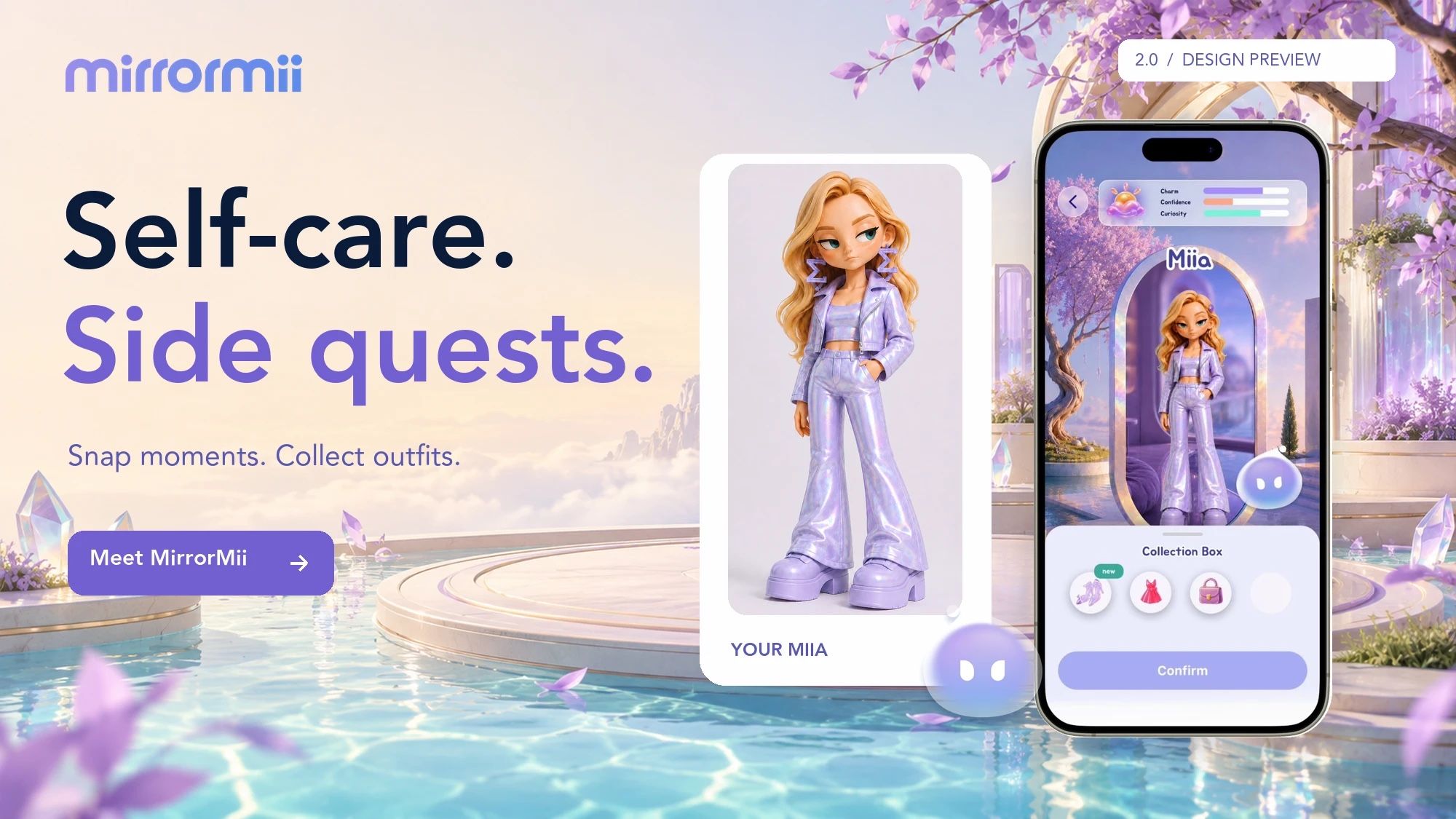
We make MirrorMii, so this is our design point of view. In MirrorMii 2.0, which is in development, a photo from your day can become a fragment for a game starring Miia. The interesting question is what happens after the photo, and whether you want to spend time in that world.

What makes a game feel cozy?
Usually, something about it lets you settle in. A familiar room with warm light, or a small job you can finish at your own pace. You might enjoy arranging a table long after the practical task is done, simply because you like being there.
The designers behind Project Horseshoe's 2017 report on coziness explored safety, softness and abundance as parts of that feeling. That is a useful design lens. Cozy games can still have challenges and consequences.
One person wants a project; another wants to watch the rain. A pale colour palette can't decide that for you. Look at what the game asks and whether you want to give it that attention tonight.
A tiny garden can feel demanding if it calls you back on a schedule you never chose. A puzzle might take more thought and still feel comfortable.
Where does the self-care part enter the game?
For us, it starts with an ordinary moment that already belongs to you. Lunch happened. You took the long way home. There is something to bring to the game without first making a grand promise about changing your life.
In MirrorMii 2.0, you take a photo and wait for its fragment to be verified. You then hand that fragment to Genii, the fairy-godmother host, yourself. It enters the Bank. The handoff is a deliberate action; the game doesn't observe everything you do in the background.
“Self-care” gets exhausting when it means another set of obligations. We'd like to make room for a moment you might rush past.
The game still needs to be worth playing afterwards.
Richard Ryan and colleagues' 2006 study of motivation in games examined autonomy and competence in players' enjoyment. That informs our interest in choices; it doesn't establish a self-care benefit for our players.
How can you tell whether the loop suits you?
Ask what a normal evening would look like. Do you spend it entering the day, or exploring something you enjoy? How much setup comes before the fun? What waits for you after a week when you simply had other things to do?
You don't need to settle the category first. A detailed log might be exactly what you wanted; a cute companion might be the reason you open it. Look for the activity you'd enjoy tonight.

For MirrorMii 2.0, our answer is a chosen photo, a fragment you decide how to use, and a character with her own life. We want the return to feel like a look into a world that kept moving. Yesterday's missing entry isn't the reason to open it.
Try describing the loop to a friend. If you can't tell what you'd actually do, look past the screenshots. Beautiful art shouldn't have to conceal the work underneath.
Does making it a game mean it helps you?
Enjoyment is a worthwhile reason to play. Gentle art doesn't prove a game improves your health or fixes a habit.
Katherine Milkman and colleagues' 2014 temptation-bundling study paired audiobooks with gym visits. It tested that particular arrangement, not whether a game connected to real life produces the same result. The useful question for us is whether the enjoyable part is enjoyable enough on its own.
Keep the part you like. Drop the record you never use. Our guide to getting back on track starts with one small action.
Where does MirrorMii fit?
MirrorMii is a cozy game, and its next version, 2.0, is not out yet. This article explains the approach we're building.

Miia is your digital twin, a reflection of you who lives her own life. In 2.0, you take a photo, wait for its fragment to be verified, then hand it to Genii yourself. You keep unspent fragments in the Bank and choose whether to use them for progression or things for Miia, such as outfits and decor.
In 2.0, choosing what Miia wears does not mean writing every part of her day. She has her own diary, relationships and little dramas. That gives you something to visit beyond the moment when you brought a photo.
Time away does not cost saved progress as an absence penalty in 2.0. There are inventory and game-progress counts, but lunch is not graded as a health result. Snap it, and Miia lives it.
FAQ
Is a cozy self-care game the same as a habit tracker?
The labels overlap in how people use them, but the central activity can differ. A tracker keeps a record. A game gives you something to play. We describe MirrorMii as a cozy game because its planned 2.0 loop leads from a chosen photo to fragments, a world and Miia's own life.
Does a cozy game have to be effortless?
No. You may enjoy a puzzle, a decorating project or a choice that takes some thought. What matters is whether you welcome that kind of effort. For us, a gentle return also means you do not have to repair lost progress just because you spent time away.
Can I play MirrorMii 2.0 now?
MirrorMii 2.0 is in development. The photos, fragments and Miia loop described here explain the version we're building. We have not announced a date or platform in this article. The illustrations show concepts. They aren't screenshots of a finished app.
Working out what suits you? Compare apps by what they ask you to do, and what you want in return. Read apps like Finch